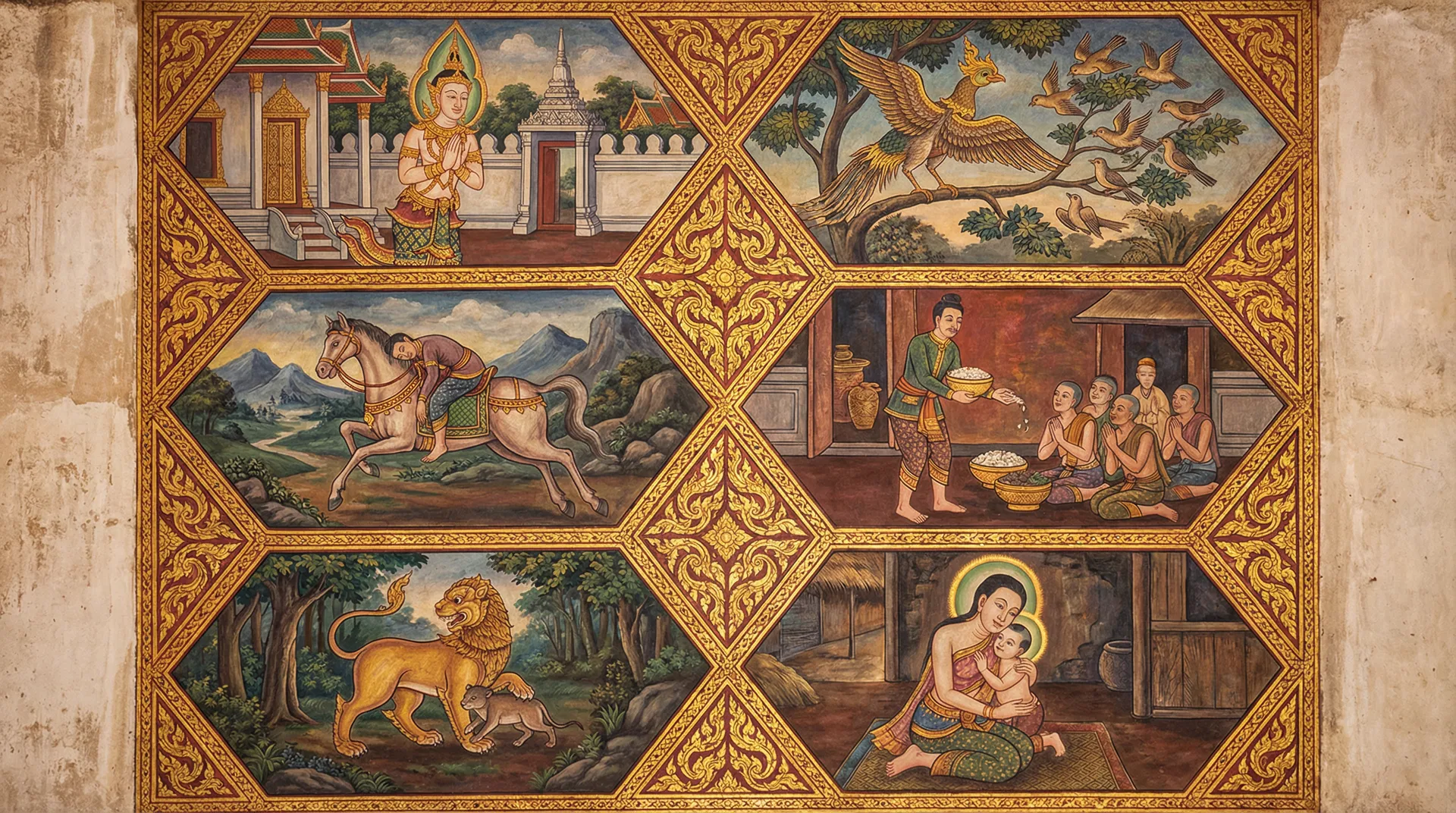
Kumbha-jātaka
Kumbha-jātaka
In a serene monastery nestled on the slopes of a gentle hill, lived a community of monks. Among them was a young novice named Ananda, known for his sharp mind and his insatiable curiosity. He was diligent in his studies and always eager to learn. However, Ananda also had a tendency to be overly confident in his own abilities, sometimes to the point of arrogance.
One day, the elder monks decided to test their novices. They brought forth a large, ornate clay pot, intricately decorated with scenes of celestial beings. "This pot," the head monk announced, his voice echoing in the quiet hall, "is filled with a rare and precious nectar. It is said to have healing properties that can cure any ailment. However, it is also incredibly fragile. Whosoever wishes to serve this nectar must demonstrate utmost care and precision. We shall choose one novice to undertake this task."
Several novices stepped forward, eager to prove their worth. Ananda, with a confident smile, was among the first. He imagined the praise he would receive for his steady hands and his focused mind.
The head monk looked at each of them, his gaze lingering on Ananda. "Ananda," he said, his tone gentle but firm, "you are known for your eagerness. Today, you shall have the honor of serving the nectar. But remember, the slightest tremor, the smallest misstep, and this precious pot will shatter, and its divine contents will be lost forever."
Ananda bowed his head, his heart filled with a mixture of excitement and a touch of apprehension. He carefully approached the table where the pot stood. It was indeed beautiful, its surface cool and smooth beneath his fingertips. He could feel the slight weight of the liquid within, a subtle sloshing sound as he gently shifted his position.
He was given a small, delicate ladle, also made of clay, designed to match the pot's fragility. Ananda took a deep breath, picturing himself perfectly executing the task. He imagined the grateful faces of the monks as he poured the nectar into their bowls.
He reached for the pot, his movements precise. He tilted it ever so slightly, the lip of the pot hovering over the ladle. He could feel the tiny vibrations from his own hands, a testament to the immense concentration he was exerting. He was so focused on the act of pouring, on the perfection of the motion, that he failed to notice the subtle shift in the floor beneath his feet.
Ananda had been practicing his meditation in this very spot just that morning. He had been so engrossed in his thoughts that he had inadvertently loosened a few floorboards. As he tilted the pot, a faint creak echoed through the hall. It was a subtle sound, but it was enough to startle him.
His concentration wavered for a fraction of a second. His hand jerked almost imperceptibly. The ladle, positioned just beneath the lip of the pot, was nudged. The pot, balanced precariously, tilted a little too far. With a sickening crack, the ornate clay pot slipped from Ananda's grasp and shattered on the stone floor. The precious nectar, the supposed cure for all ailments, splashed and evaporated, leaving only a faint, sweet scent in the air.
A hush fell over the hall. Ananda stood frozen, his face pale, the broken pieces of the ladle scattered around his feet. He had failed. His confidence had turned to ash, replaced by a crushing sense of shame and regret.
The head monk approached him, his expression not of anger, but of gentle understanding. He placed a hand on Ananda's shoulder. "Ananda," he said softly, "you were so focused on the act of serving, on the outward performance, that you forgot to be aware of your surroundings. You forgot that true service requires not just skill, but also mindfulness and a deep respect for the object of your service."
He continued, "The pot was fragile, yes, but the true fragility lies in our own minds when we are consumed by pride. Your confidence blinded you to the subtle dangers, to the very ground upon which you stood. You did not fail because you lacked skill, but because you lacked complete awareness and humility."
Ananda, tears welling in his eyes, understood. He had been so eager to impress, so certain of his own perfection, that he had overlooked the simplest precautions. He realized that true mastery comes not from boasting of one's abilities, but from cultivating a quiet, mindful presence, and from recognizing the interconnectedness of all things.
From that day forward, Ananda dedicated himself to cultivating humility and mindfulness. He learned that true service is an act of reverence, performed with a quiet heart and an observant mind, understanding that even the smallest detail, the slightest oversight, can have significant consequences.
— In-Article Ad —
💡Moral of the Story
True skill and service are not merely about outward performance or confidence, but about complete awareness, humility, and a deep respect for the task and its surroundings. Pride can be a greater source of failure than lack of ability.
Perfection: Humility
— Ad Space (728x90) —
More Jataka Tales You May Enjoy
 307Catukkanipāta
Sūci-Jātaka
The Needle's TaleIn the vibrant city of Kosambi, lived a king named Bhimasena. He was known for his ...
💡 True value is found not in the material itself, but in the skill, patience, and mindfulness with which it is used. Every action should be purposeful, flowing seamlessly into the next, minimizing waste and maximizing the impact of our efforts.
 226Dukanipāta
Mūga-pakkhajātaka
The Tale of the Mute Bird In the ancient city of Mithila, nestled amidst lush greenery and shimmerin...
💡 Past actions and their consequences can be overcome through genuine compassion, empathy, and a transformed heart. Understanding and alleviating the suffering of others can lead to the resolution of past karmic debts.
 76Ekanipāta
The Tale of the Fragrant Tree
The Tale of the Fragrant Tree In the heart of a vast and ancient forest, where sunlight dappled thr...
💡 Curiosity, coupled with the courage to learn new things, can lead to great discoveries that benefit society.
85EkanipātaVessantara Jātaka
Vessantara Jātaka In the magnificent kingdom of SiBī, ruled the noble King Sanjaya and his virtuous ...
💡 True generosity comes from the heart and requires immense courage and sacrifice. The practice of giving, even when it leads to personal suffering, leads to profound spiritual merit and liberation.
102EkanipātaSattigumba Jātaka
The Story of the Spear-Bearing Tree In a time long past, when the world was wilder and the whispers ...
💡 Distrust and suspicion, while seemingly protective, ultimately lead to isolation and inner barrenness. True security and fulfillment come from cultivating trust, understanding, and genuine connection with others.
3EkanipātaThe Bodhisattva and the Golden Deer
The Bodhisattva and the Golden Deer In the ancient kingdom of Mithila, nestled amidst emerald fores...
💡 Selfishness and the failure to help others lead to suffering. When we help others, we receive good in return.
— Multiplex Ad —